Slide transcript
~15-20% FEEDSTOCK MASS DELIVERING ~25-40% BIOGAS OUTPUT
| Feedstock type | Biogas yield range (m3 / tonne) | Multiplier vs MSW | Source |
|---|---|---|---|
| MSW organic | 80 – 120 | 1.0x baseline | Penang reference range |
| Animal feedstock | 300 – 500 | 3 – 5x | Manure / slaughterhouse / livestock byproducts |
| SPV | MSW organic (tpd) | Animal (tpd) | Total organic (tpd) | Animal mass share | Source catchment |
|---|---|---|---|---|---|
| PD Pasarjaya | 315 | 0 | 315 | 0% | — |
| Bandung | 350 | 75 | 425 | 17.6% | West Java — Bandung Regency, Garut, Subang, Cianjur |
| Lampung Selatan | 250 | 75 | 325 | 23.1% | Lampung Selatan dairy and poultry near Kec. Natar |
WHY THIS MATTERS
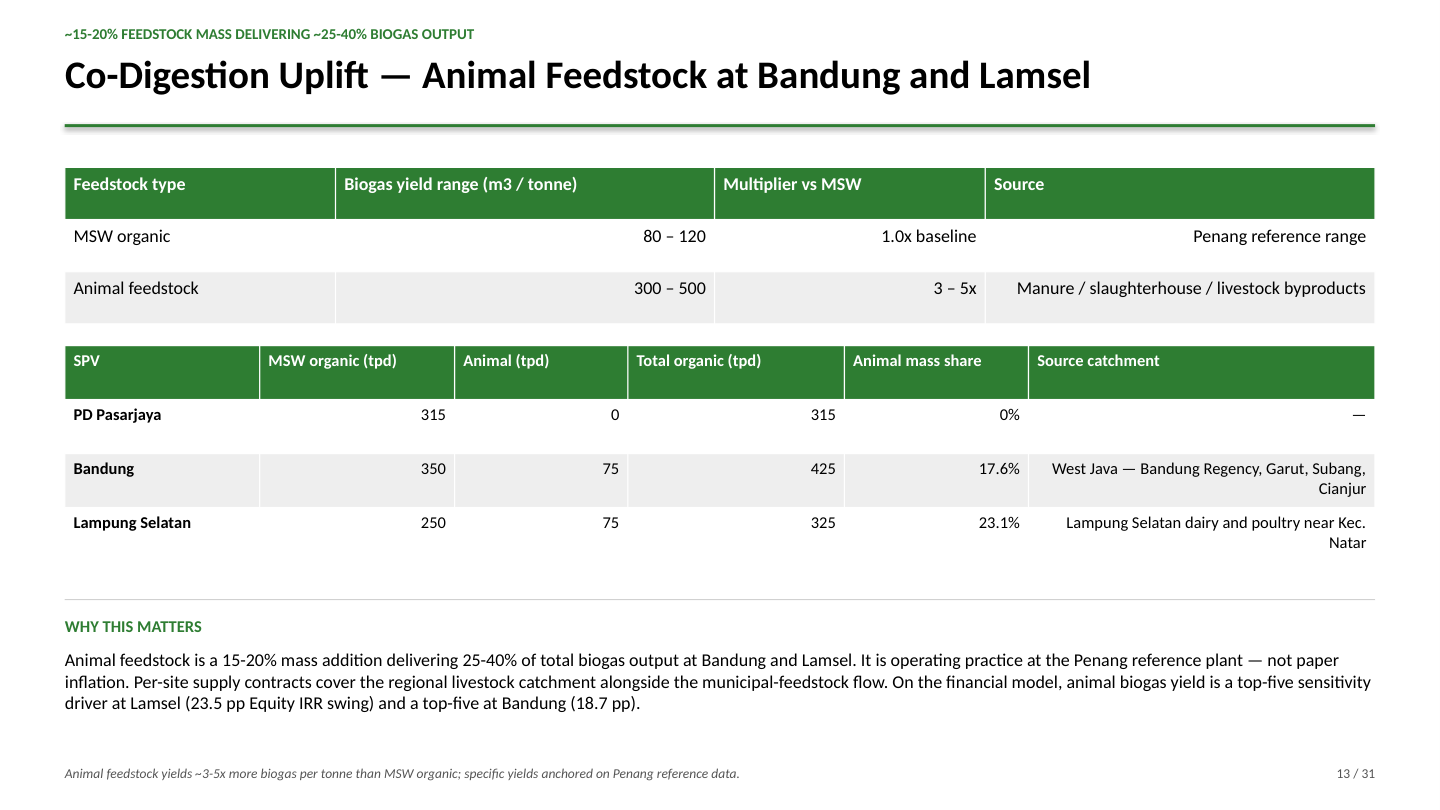
Animal feedstock is a 15-20% mass addition delivering 25-40% of total biogas output at Bandung and Lamsel. It is operating practice at the Penang reference plant — not paper inflation. Per-site supply contracts cover the regional livestock catchment alongside the municipal-feedstock flow. On the financial model, animal biogas yield is a top-five sensitivity driver at Lamsel (23.5 pp Equity IRR swing) and a top-five at Bandung (18.7 pp).
Animal feedstock yields ~3-5x more biogas per tonne than MSW organic; specific yields anchored on Penang reference data.